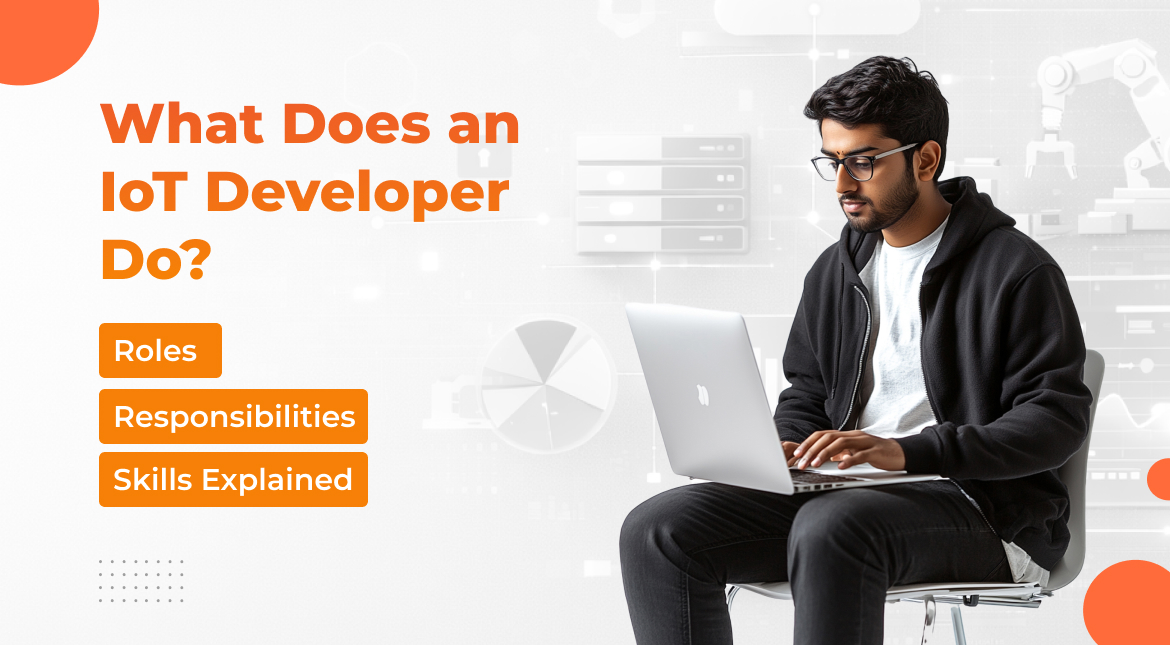
An IoT developer builds – solutions connecting devices to the internet. IoT solutions allow them to – gather, exchange, and process data. IoT developers are empowering modern businesses. They run operations by – crafting networks of connected systems.
Expert IoT developers conceptualise the architecture to facilitate custom IoT development services. A reliable IoT development company develops custom IoT software solutions. They power interconnected devices. IoT solutions enable – real-time analytics and automation.
From smart homes to industrial apps – IoT delivers scalable tech solutions. We will discover the role, responsibilities and skill sets of an IoT developer. And how an IoT developer can enable custom IoT development services.
Who is an IoT Developer?
An IoT developer is a software and hardware expert. This expert builds and blends IoT applications that connect physical devices online. They help sensors, machines, and systems share information. This enables devices to work together intelligently 991 billion USD market in 2028 by Gartner, stakeholders can now comprehend the growth rates of IoT offerings.
What Problems IoT Developers Resolve:
- They connect disparate devices into unified networks.·
- Ensure secure data transfer between – sensors, apps, and cloud platforms.
- Optimize device performance, scalability, and responsiveness
- Solve interoperability challenges across multiple platforms.
Where they Fit in IoT Ecosystems:

- They fit in sensors, microcontrollers, and embedded systems at – device layer,
- Ensure communication between devices and gateways – at the network layer.
- Building dashboards, analytics, and interfaces – at application layer.
- IoT data with automation systems at – cloud/AI layer.
Core Responsibilities of an IoT Developer
With IoT application development services,you can develop smart software solutions. It includes programming to power connected devices. Testing ensures reliability and performance. Deployment manages data and enables IoT operations.
An IoT developer’s core responsibilities include – connecting devices and enabling secure data exchange. They easily integrate systems with cloud platforms. These developers ensure IoT solutions are – scalable and interoperable. The demand for IoT devices is upsurging. The number of IoT devices globally is – estimated to be 40.6+ billion IoT devices by 2034
Device and Sensor Integration
With device and sensor integration, IoT developers can – enable hardware interfacing. They connect physical hardware with digital systems for communication. Developers ensure sensors and controllers link correctly with circuits.
This involves configuring ports, protocols, and drivers so devices can exchange signals. Once connected – sensors follow data collection logic to capture readings. These readings include temperature, motion, or pressure.
The logic defines how data is – gathered and transmitted to apps. Hardware interfacing and data collection logic enable IoT systems. They allow them to sense and respond smartly.
Manufacturers are progressively blending –IoT devices and sensors into production lines. These integrations enable – real‑time monitoring and predictive maintenance. By embedding sensors – companies can gather continuous – temperature and energy usage insights.
Connectivity & Protocol Management
With connectivity and protocol management, IoT developers ensure devices can communicate reliably. Options include Wi‑Fi for high‑speed local connections and Bluetooth for short‑range pairing.
LTE supports wide‑area mobile connectivity. LoRaWAN enables – long‑range and low‑power communication. Developers choose protocols based on – range, bandwidth, and energy efficiency needs.
They implement secure data transmission to protect sensitive information. Encryption, authentication, and safe routing keep – IoT networks resilient against cyber threats.
The IoT in smart cities is a – technology necessity for the urban ecosystem. IoT is transforming the approach – public administration runs. From traffic lights rejoining to – air quality sensors – all of this is inter-connected with newest technologies.
Backend and Cloud Development
With Backend and cloud, IoT developers power the data flow behind IoT systems. It starts with data ingestion. The sensor readings are collected and streamed into cloud platforms.
Developers design pipelines to – process, filter, and store this data. They build APIs that allow devices, apps, and services to access information.
Microservices break complex IoT functions into smaller modules. This enables scalability and flexibility. Data ingestion, APIs, and microservices ensure IoT systems remain responsive.
Application Layer Development
With application layer development, IoT developers focus on – creating user‑facing tools. These tools make IoT data actionable. Developers create web dashboards to – display sensor data. These dashboards show analytics in real-time for – smarter decisions.
These dashboards include – charts, alerts, and control panels for managing devices. On the mobile side, applications provide portability, letting users monitor IoT systems anywhere.
Mobile apps integrate – push notifications, voice commands, and location‑based features for convenience. Web dashboards and mobile apps ensure – IoT solutions are accessible.
Security and Compliance Implementation
With security and compliance implementation, IoT developers protect systems from – unauthorized access. Developers use authentication methods to verify users.
Encryption secures sensitive data as it moves between – devices and networks. Compliance with industry standards ensures – systems meet regulatory requirements. Authentication and encryption build – resilience in IoT solutions.
Skills Required to Become an IoT Developer
IoT developers enable – hardware, connectivity, and cloud. They blend technical depth with problem‑solving capabilities to build scalable IoT solutions.
Programming Skills
With programming skill sets, IoT developers connect – hardware with software systems. They use embedded languages like – C, C++, or Python to program sensors.
On the server side, backend technologies such as – Java, Node.js, or .NET manage workflows. Embedded coding and backend development ensure IoT devices run smoothly.
Hardware & Firmware Knowledge
With hardware and firmware acquaintance, IoT developers connect – devices with digital systems. They program microcontrollers to manage – sensors and device operations.
Understanding sensors and gateways ensures accurate data capture. And smooth communication across networks. Hardware control and firmware coding make IoT devices responsive.
Cloud and Data Skills
With cloud and data skills, IoT developers manage – large volumes of device information. They use cloud platforms like – AWS, Azure, or Google Cloud to scale IoT data.
Strong knowledge of data processing helps in – cleaning and analyzing sensor inputs. Cloud expertise and data handling ensure – IoT systems remain insightful.
Security & Networking Expertise
With security and networking specialization, developers ensure – IoT systems stay connected. Developers implement secure communication with encryption and authentication. This protects data in transit.
They manage devices by – monitoring access and updates. They ensure connectivity across networks. Secure communication keeps – IoT ecosystems reliable.
Tools & Technologies Commonly Used by IoT Developers
IoT developers use advanced tools for cloud platforms such as – AWS IoT or Azure IoT.They rely on technologies like – MQTT, Node.js, and analytics frameworks to build smart systems.
- Development Platforms
Arduino, Raspberry Pi, and Kaa IoT platform are used to – manage IoT applications. Open‑source IoT platform like ThingsBoard is leveraged to enable – device management and dashboards.
- Cloud Services
IoT‑enabled cloud services combine – IoT with cloud computing. These tools connect – devices, collect data, and deliver insights. They allow businesses to – store and analyze sensor data. They ensure secure communication and integrations.
- Communication Protocols
IoT developers use – high‑speed local connectivity for smart homes. Short‑range protocols are used for wearable devices. Long‑range protocols are ideal for – industrial IoT and smart cities.
- Testing and Monitoring Tools
IoTIFY, Postman, and JTAG help developers test – IoT systems effectively. Wireshark analyzes – communication traffic for debugging. LoadRunner simulates heavy workloads to – measure IoT performance.
Datadog helps track IoT infrastructure. AWS CloudWatch and Azure Monitor provide cloud‑based monitoring. Nagios checks – device health and network status in real-time.
How IoT Developers Contribute to Custom IoT Development Services?
IoT developers translate – business needs into practical solutions. This must align with client goals. They design scalable IoT architectures to – handle growing devices.
IoT developers support product development services at every stage
- They take products from – prototyping to full deployment.
- Ensure integration of hardware, software, and cloud systems.
- Their expertise helps reduce technical and operational risks.
- They support – secure and reliable IoT solutions for businesses.
In-House IoT Developer vs Working with an IoT Application Development Company.
| Aspect. | In‑House IoT Developer. | IoT Application Development Company. |
|---|---|---|
| Skill Gaps in Startups & Enterprises. | Gaps in IoT skills, requiring extra training or hiring. | Access to experts across -hardware, software, cloud, and security. |
| Faster Time‑to‑Market. | Development speed depends on internal resources and expertise. | Accelerates delivery with established processes and experienced teams. |
| Access to Multidisciplinary Teams. | Limited skills of internal teams. | Offers access to -engineers, data scientists, and UX designers. |
| Long‑Term Support. | Constrained support by budget & staff turnover. | Ensures – maintenance, upgrades & scalable solutions. |
IoT Development Services That Rely – Heavily on IoT Developers
IoT consulting helps businesses identify opportunities and design strategies. Consultants guide organizations in – aligning IoT projects.
Product engineering focuses on – building IoT devices and applications
- IoT engineers ensure – hardware, software, and cloud systems work seamlessly.
- Platform development creates – scalable environment and manages devices.
- Maintenance and optimization empower – ongoing IoT projects.
Demand for IoT Developers in 2025
The number of IoT devices across all industries is – predicted to mature by 80+ billion by 2033. So, the industry demand for – IoT developers is rising. Businesses adopt connected solutions across sectors. Startups often need IoT developers to wear multiple hats.
Enterprises focus on specialized IoT roles in – security, cloud, and analytics
- Future trends highlight – AI integration, edge computing, and networking.
- The growing career path roles include – solution architects and IoT consultants.
- Demand for IoT developers will stay strong – driven by smart cities.
How Businesses Benefit from Expert IoT Developers
Expert developers from an IoT application development company assures – product reliability. They build – secure architectures that protect data from cyber threats.
- IoT developers’ skills enable faster innovation cycles.
- They help businesses launch solutions quickly.
- IoT development advantages lead to better ROI.
- IoT-driven integrations maximise value from IoT investments.
Key Takeaways!
So, IoT developers play a vital role in – transforming ideas into connected solutions. Their expertise ensures reliable devices and secure architectures.
By guiding businesses through – IoT consulting, engineering, and development, we accelerate innovation. Our custom IoT development services empower organizations to – align technology with their unique business goals.
Partnering with an experienced IoT development team with us at DaptonCS ensures – secure and scalable IoT-driven solutions. This collaboration will help your business – unlock efficiency, improve customer experiences, and stay competitive.