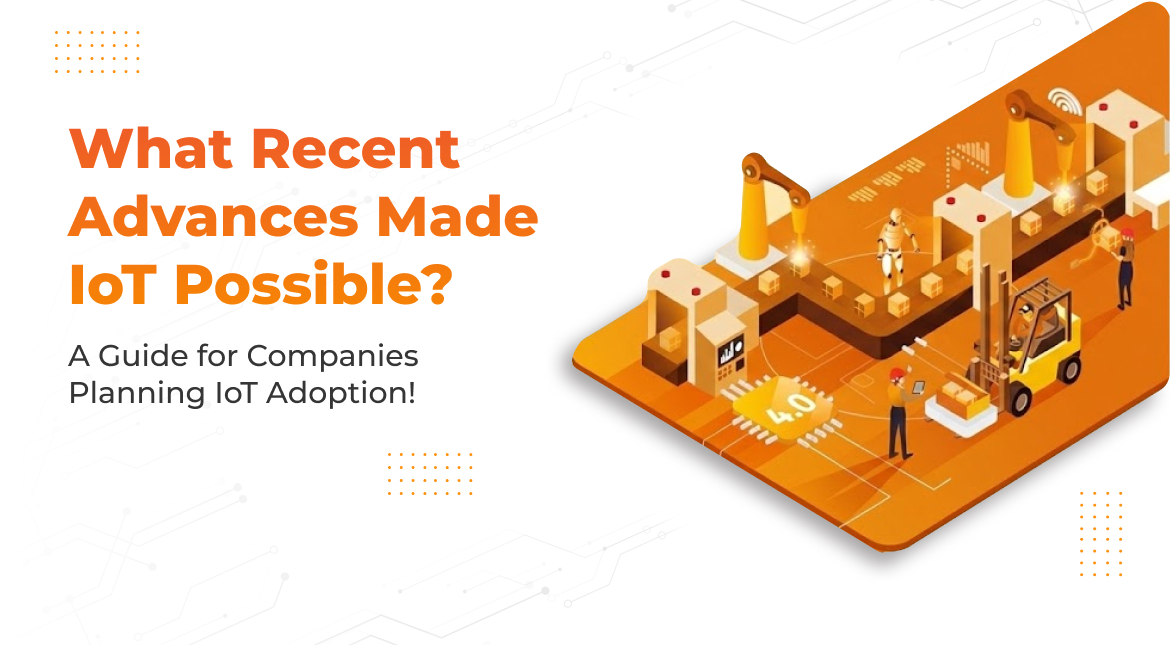
The Internet of Things (IoT) has arisen as the – spine of an interconnected world. It has restyled how we enable current ecosystems. There is a swift IoT adoption progressing at the core of the innovation. This scenario is due to the instant response by modern infrastructure.
Powerful sensors and advanced hardware are enhancing accuracy levels. Connected devices are reshaping supply chains. Even IoT development services are enabling highly complex automations.
In addition, real‑time data processing is driving cloud computing. Smart homes are increasingly – embracing IoT solutions. IoT is constantly – revolutionizing healthcare. And continuous data now flows between interlinked devices. So, there is far more to uncover with IoT in both technology and business.
Thus, we have come up with this guide for organizations that want to adopt IoT solutions. We will also explore how IoT advancements can assist your company in steering growth.
What Is IoT?
Internet of Things (IoT) connects – devices, sensors & systems. These devices exchange data – in real time. Smarter decisions are enabled through automation. Efficiency improves across – modern operations.
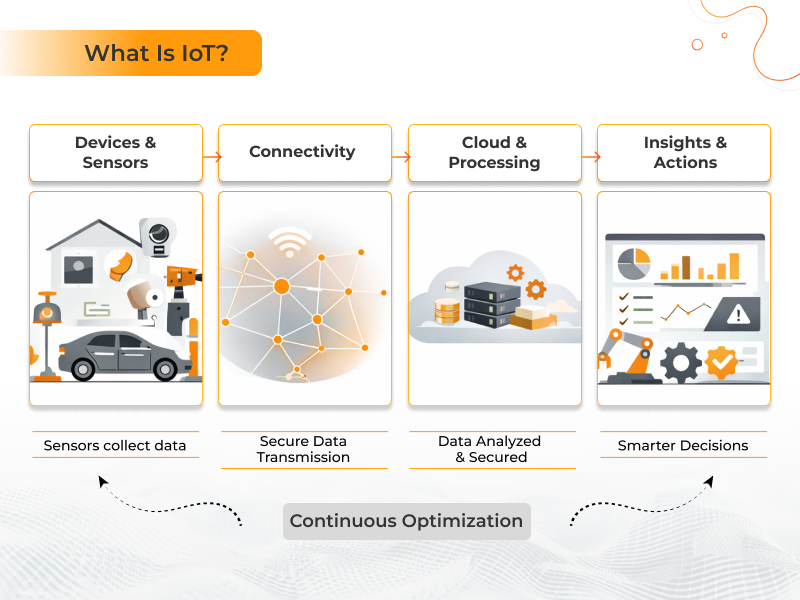
In 2025, IoT is the backbone of – digital ecosystems. Industries rely on IoT – for transformation. Smart cities thrive with connected solutions. Healthcare, logistics, and homes are powered by IoT.
IoT Was Not Feasible Earlier Due To:
- Connectivity: Earlier, internet bandwidth was limited. Mobile networks were slow. Without 4G/5G and emerging 6G – IoT could not scale globally.
- Hardware Costs: Producing sensors and chips was costly. Smart devices were difficult to scale affordably.
- Data Processing: Legacy infrastructure lacked real‑time data processing power. Cloud and AI analytics were not mature enough.
- Security: Early IoT systems faced breaches with weak security. Limited encryption increased risks. Enterprises hesitated to connect due to data theft.
Key Technological Advances That Made IoT Possible.
Advances in custom IoT development services are now possible. Scalability allows systems to grow with millions of devices. Reduced infrastructure costs are – making IoT cost-effective for startups.
Furthermore, IoT solutions now – deliver insights with minimal effort. Authentication technologies keep networks secure. Together, these innovations connect billions of devices.
Affordable & Powerful Sensors and Hardware.
Today, powerful sensors drive IoT growth. Cost reduction makes devices more accessible. Improved accuracy ensures reliable data collection. Strong hardware makes IoT solutions consistent.
In addition, miniaturization allows – sensors to fit into tiny spaces. Together, these advances make – IoT highly efficient for businesses.
High-Speed & Low-Power Connectivity.
With 5G you get – ultra-fast connectivity for IoT devices. LPWAN supports – long-range and low-power communication. NB-IoT enables connections for massive device networks.
LoRaWAN provides cost-effective coverage. Reliability improvements ensure – stable device communication. Better coverage expands IoT into remote regions. These technologies make – IoT accessible to businesses.
Cloud Computing & Scalable Infrastructure.
Cloud computing enables – real-time data processing. Elastic scalability lets systems grow or shrink. Reduced infrastructure costs make IoT adoption affordable.
The worldwide IoT cloud platform market size was valued at $ 22.04 billion in 2025 and expected to reach . It exhibits a CAGR of 24.5 percent during this forecasted period.
Furthermore, Hybrid cloud setups balance security across businesses. Scalable infrastructure supports numerous connected devices. Together, these advances empower modern IoT solutions.
Edge Computing & Real-Time Processing.
Edge computing now delivers faster response times. Reduced latency improves real-time decisions. Offline reliability keeps devices working.
Edge AI will enable – devices to adapt locally. It is improving autonomy without continuous data uploads. The explosion of edge-enabled IoT devices is predicted to reach 40603.6 million in the consumer sector by 2034.
Local data processing reduces dependence on servers. Real-time insights – enhance automation. Together, these advances make – IoT more resilient. It enables businesses to easily process data.
Advances in Data Analytics & AI.
Data analytics delivers – predictive insights. AI enables automation across industries. Business intelligence enables clear strategies.
In 2025, Telia introduced the – Telia IoT Platform. This assisted Nordic enterprises scale IoT-driven solutions. The platform facilitates data gathering, visualization, and action from interconnected devices. They now have in-built AI for precise analysis and optimization. Telia also launched its first add-on service – Telia IoT tracking and monitoring.
Predictive models help anticipate trends. Automation further reduces redundancies. BI dashboards provide visibility into growth. These advances turn IoT data into insights. They make decision-making faster.
Improved Security & Device Management.
Authentication verifies trusted users. Encryption protects data during transmission. Secure firmware updates keep devices safeguarded.
In January 2025, the U.S. launched a cyber trust mark for IoT-steered devices. This enables consumers. They can access the – cybersecurity benchmarks effortlessly. It displays that the products have met cybersecurity protocols as per the benchmarks set by the U.S. (Information Source: https://www.infosecurity-magazine.com
Strong security builds confidence in IoT systems. Precise device management ensures smooth operations. Together, these advances protect IoT networks. And enable businesses to secure data sets.
How These Advances Transformed IoT Adoption for Companies.
Faster time-to-market helps – companies launch IoT solutions quickly. Lower entry barriers make adoption easier. Improved ROI delivers measurable business value.
- IoT investments show clear performance outcomes.
- Scalability supports diverse industry applications.
- Flexible solutions adapt to different business needs.
- Global adoption accelerates through these advances.
- Companies gain confidence in IoT adoption.
Industries Benefiting Most from – Modern IoT Capabilities.
- Manufacturing Domains.
- IoT enables predictive maintenance.
- Smart sensors improve production efficiency.
- Real-time monitoring enhances worker safety.
- Healthcare Sector.
- Connected devices enable remote patient tracking.
- Wearables track vital signs continuously.
- IoT improves hospital asset management.
- Logistics & Supply Chain.
- IoT provides – real-time vehicle tracking.
- Smart sensors monitor temperature
- Predictive analytics reduces delivery delays.
- Smart Buildings & Cities.
- IoT systems reduce waste.>
- HVAC improves sustainability.
- Connected infrastructure enhances safety.
- Retail & Energy.
- Enable inventory management.
- Personalize shopping experiences.
- Smart shelves reduce losses.
Why Companies Now Rely on Professional IoT Development Services.
Modern IoT stacks are complex and need expert handling. However, experienced IoT developers help with device connectivity.
Integration challenges require specialized development skills. Nevertheless, IoT product engineering links legacy and modern systems. The IoT product engineering market is expected to – reach $242.2 billion by 2030. It will mature at a CAGR of – 21.3 percent from 2024.
Security and compliance need monitoring. Enterprise IoT platforms possess safety and compliance management capabilities. The enterprise IoT platforms market was – $16.11B in 2025. It is projected to – boost to $49.17B by 2034
Long-term scalability depends – on a robust architecture. Businesses can partner with an IoT application development company. With this alliance businesses can boost efficiency.
Key Role of an – IoT Application Development Company in IoT Adoption.
Let us explore the responsibilities of an IoT application development company.
Strategy & Consulting.
- Experts guide companies with IoT roadmaps.
- Consulting aligns IoT goals with objectives.
- Strategic planning accelerates IoT adoption.
Architecture Design.
- Professionals design scalable and secure IoT architectures.
- Robust frameworks ensure smooth device integration.
- Well-structured design supports long-term growth.
Platform Development.
- Developers build IoT platforms for diverse needs.
- Platforms enable automations.
- Tailored solutions improve usability.
Deployment & Optimization.
- Companies get support for IoT deployment.
- Optimization enhances performance.
- Expert oversight ensures scalability.
When to Choose Custom IoT Development Services?
Businesses choose – custom IoT for unique workflows. Off-the-shelf tools often miss complex needs. Tailored solutions fit industry-specific requirements. Custom IoT ensures flexibility and scalability. You must choose custom IoT development services when your –
- Compliance needs tailored approaches.
- Legacy systems need specialized integrations.
- Custom IoT connects both old and modern platforms.>
- Scalability makes personalized solutions significant.
- Businesses grow as devices and data expand.
- Healthcare and finance require strict security.
Steps for Companies Planning IoT Adoption in 2025.
Let us explore – how these IoT adoption steps guide businesses. And take them toward future-ready transformation.
- Define business objectives.
- Set clear IoT goals.
- Align with the overall business strategy.
- Assess technical readiness.
- Review current infrastructure.
- Identify gaps in skills and systems.
- Choose the right technology stack.
- Select scalable platforms.
- Compatibility with devices and apps.
- Partner with the right experts.
- Work with Custom IoT development services providers.
- Gain guidance on integration and compliance.
- Plan for security & scalability.
- Build strong data protection measures.
- Design systems for future growth.
Common Challenges in IoT Adoption (and How Advances Solve Them).
IoT adoption struggles with connectivity reliability. Data overload creates challenges in managing information. Security risks make protection a critical priority. Operational complexity slows down implementation.
These challenges require smart solutions for – successful IoT adoption, such as:
- Connectivity reliability improves with stronger networks.
- Edge computing ensures faster local processing.
- Data overload is handled by smart analytics.
- Cloud platforms simplify large-scale data management.
- Security risks are reduced with encryption.
- Compliance frameworks strengthen trust and safety.
- Operational complexity is simplified by automation.
- Unified IoT platforms streamline management and growth.
How the Right IoT Company Accelerates Growth?
A mid-sized manufacturing firm partnered with an IoT solutions company. Production monitoring was modernized with IoT sensors. Cloud-based analytics enabled machine visibility. Predictive alerts reduced downtime by 22%. System responsiveness improved. And latency was trimmed by 40%.
- Streamlined data empowered faster managerial decisions. Throughput increased with consistent product quality. IoT insights drove growth and cost efficiency.
- Energy consumption was – tracked and optimized in real time. Maintenance schedules became proactive – rather than reactive. Operators gained instant alerts – on machine health.
- Data integration connected shop-floor systems. Managers accessed dashboards for performance reviews. Production bottlenecks were identified. And blockages were eliminated.
- Real-time insights amended operational transparency. Machine utilization was traced with precision. Workflow efficiency increased across departments. Resource allocation became balanced.
- Employee workload was reduced through automation. Routine tasks were handled by intelligent systems. Customer orders were fulfilled faster. Delivery timelines became more predictable. Service quality improved across operations. Increased efficiency boosted performance.
Moving Forward with End-To-End IoT Solutions!
So, we explored the advances in – connectivity and edge computing. Cloud platforms make – IoT adoption easier. Manufacturing, healthcare & logistics are transforming. Smart cities are advancing quickly – with modern IoT solutions.
Businesses are unlocking – ROI and new revenue opportunities. Expert execution brings true value to IoT projects. However, without strategy and architecture, solutions may fail.
Compliance oversight ensures secure IoT adoption. Partnering with right IoT experts assure – security and scalability.
If you are planning IoT adoption in 2025 – now is the time to act. Connect with a trusted IoT development services provider like DaptonCS. Our teams – develop, design and optimize IoT solutions. IoT solutions will make your business future-ready.