

ERP implementation is the structured process of deploying and configuring an enterprise resource planning system to align with a company’s operations, data, and long-term goals. A successful implementation requires planning, customisation, data migration, testing, training, and continuous optimisation. Businesses that work with a reliable custom erp software development company improve deployment speed, reduce operational disruption, and increase user adoption. This guide explains every phase of ERP implementation in a clear, step-by-step format to help organisations launch their ERP system with confidence.
Why ERP Implementation Matters More Than You Think
Buying ERP software is only the first step. Implementation determines whether the system delivers value or becomes a costly burden.
According to research published by Microsoft, nearly 75% of ERP projects face schedule delays due to poor planning and change management. Meanwhile, an ERP Report consistently shows that organisations with structured implementation strategies achieve faster ROI and higher user satisfaction.
ERP implementation is not just technical setup. It involves:
- Business process alignment
- Data accuracy
- Departmental coordination
- Change management
- Ongoing optimisation
When handled strategically, erp software development combined with structured deployment can significantly improve reporting accuracy, operational efficiency, and decision-making speed.
What Is ERP Implementation?
ERP implementation is the process of configuring, customising, integrating, testing, and deploying an ERP system within an organisation.
It includes:
- System configuration
- Data migration
- Workflow customisation
- Integration with existing tools
- User training
- Go-live and support
Many companies confuse ERP purchase with ERP implementation. However, implementation is where the real work begins. Without proper planning and execution, even the best system may fail to deliver results.
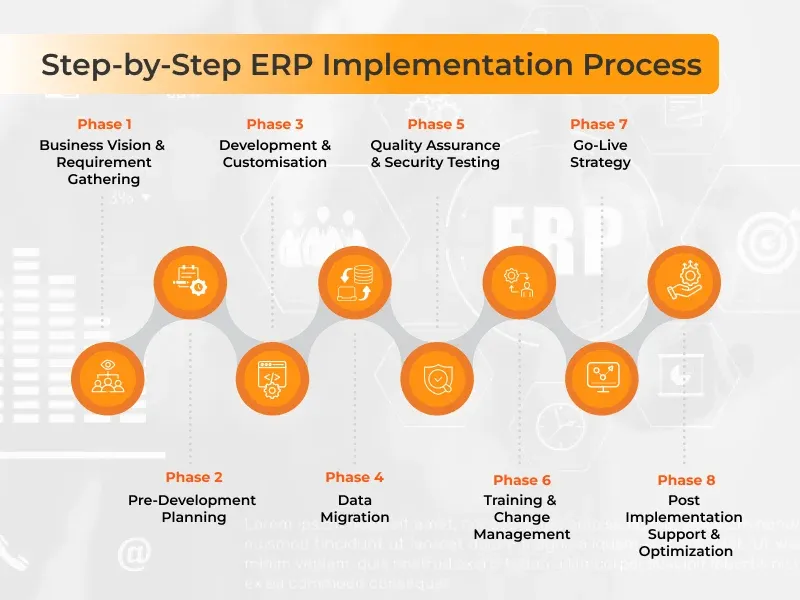
Step-by-Step ERP Implementation Process
Below is a practical breakdown of each phase businesses should follow.
Phase 1: Business Vision & Requirements Gathering
Now, document everything.
This stage focuses on understanding how your business operates today and how it should operate tomorrow.
Tasks include:
- Mapping existing workflows
- Identifying inefficiencies
- Documenting integration requirements
- Listing compliance needs
- Creating a functional requirements document
An experienced erp software development company helps translate business requirements into technical specifications.
This blueprint becomes your ERP roadmap.
Phase 2: Pre-Development Planning
This phase lays the foundation for the entire project.
Start with clarity. Define measurable goals.
Ask questions like:
- What problems must the ERP solve?
- Which departments will use it first?
- What KPIs will measure success?
- What risks could impact deployment?
During this phase, many businesses consult custom erp software development services to identify customisation requirements early. Clear documentation prevents confusion later.
Key activities include:
- Setting a project timeline
- Defining scope
- Identifying stakeholders
- Allocating budget and resources
- Performing risk assessment
Strong planning reduces scope creep and cost overruns.
Phase 3: Development & Customisation
This is where the ERP system takes shape.
Out-of-the-box ERP rarely fits perfectly. Customisation ensures alignment with unique workflows.
During this stage:
- Modules are configured
- User roles are defined
- Dashboards are created
- Integrations are developed
- Reports are customised
A professional custom erp software development company ensures modifications do not compromise system stability.
Customisation must stay controlled. Over-customisation increases maintenance complexity. Balance flexibility with scalability.
Phase 4: Data Migration
Data is the backbone of ERP.
Poor migration can damage trust in the new system.
The process usually follows ETL methodology:
- Extract data from legacy systems
- Transform and clean data
- Load data into the new ERP
Key considerations:
- Remove duplicate records
- Standardize formats
- Validate accuracy
- Back up existing databases
According to Gartner, poor data quality costs organisations millions annually in operational inefficiencies. Clean migration protects business continuity.
Phase 5: Quality Assurance & Security Testing
Testing ensures stability before launch.
Testing stages typically include:
- Unit testing
- System testing
- Integration testing
- User Acceptance Testing (UAT)
UAT is critical. Real users must test real workflows.
Encourage employees to provide feedback. Address issues early. This prevents costly post-launch disruptions.
Phase 6: Training & Change Management
Technology adoption fails without user acceptance.
Training must be:
- Role-based
- Practical
- Scenario-driven
- Easy to access
Change management reduces resistance. Leaders should communicate:
- Why ERP is being implemented
- How it improves daily work
- What support employees will receive
Organisations that invest in structured training experience higher adoption rates and faster productivity gains.
Phase 7: Go-Live Strategy
There are two common deployment methods:
- Big Bang Approach
- All modules launch simultaneously
- Faster transition
- Higher short-term risk
- Phased Rollout
- Gradual deployment
- Lower operational risk
- Easier troubleshooting
Before going live:
- Perform final backups
- Confirm system security
- Ensure IT support readiness
- Prepare issue escalation process
Careful preparation minimises downtime.
Phase 8: Post-Implementation Support & Optimisation
ERP implementation does not end at go-live.
Continuous improvement matters.
Post-launch activities include:
- Monitoring performance
- Fixing minor issues
- Updating features
- Enhancing reporting tools
- Adding new modules
Businesses that treat ERP as a long-term strategic asset achieve better returns.
Best Practices for Smooth ERP Implementation
Follow these proven strategies:
- Secure executive sponsorship
- Maintain clear communication
- Set realistic timelines
- Avoid scope expansion mid-project
- Keep documentation updated
- Assign internal ERP champions
- Schedule regular milestone reviews
Working with experienced custom erp software development services reduces risk and ensures long-term scalability.
Common ERP Implementation Challenges (And Solutions)
Scope Creep
Solution: Freeze requirements before development begins.
Poor Data Quality
Solution: Clean and validate data before migration.
Employee Resistance
Solution: Communicate benefits early and train thoroughly.
Budget Overruns
Solution: Conduct detailed planning and phased delivery.
Integration Failures
Solution: Test all third-party integrations before go-live.
Preparation prevents most problems.
How to Measure ERP Implementation Success
Track performance using measurable KPIs:
- Reduction in manual processes
- Improved reporting speed
- Decrease in operational errors
- Increased productivity
- Faster financial closing cycles
- Higher user adoption rates
Data-driven evaluation confirms ROI.
Final Thoughts
ERP implementation requires discipline, clarity, and collaboration. It is not just a technical deployment. It is a business transformation process driven by structured planning and careful execution. To better understand the broader impact of modern ERP systems worldwide, it is important to recognise how strategic deployment directly influences efficiency, transparency, and scalability across industries. When guided by experienced professionals and supported by clear internal leadership, ERP systems can deliver long-term efficiency, transparency, and scalability.
When guided by experienced professionals and supported by clear internal leadership, ERP systems can deliver long-term efficiency, transparency, and scalability.
A structured approach makes the difference between failure and measurable success.
Ready to Implement ERP the Right Way?
ERP implementation is complex. One wrong decision can delay operations, increase costs, and reduce user adoption. But the right strategy changes everything. If you’re planning an ERP rollout, upgrading legacy systems, or building a fully tailored solution, choosing the right ERP implementation partner ensures structured planning, business-first customisation, seamless data migration, secure system integration, long-term scalability, and dedicated post-launch support.
If you’re planning an ERP rollout, upgrading legacy systems, or building a fully tailored solution, working with an experienced custom erp software development company ensures:
- Structured implementation planning
- Business-first customisation
- Seamless data migration
- Secure system integration
- Long-term scalability
- Dedicated post-launch support
We don’t just deploy ERP systems.
We align them with your business goals.
Frequently Asked Questions:
What are the main phases of ERP implementation?
ERP implementation includes planning, requirement gathering, customisation, data migration, testing, training, go-live, and post-launch optimisation.
How long does ERP implementation take?
Timelines vary based on business size and complexity. Small implementations may take 3–6 months, while large enterprises may require 12–18 months.
Why is customisation important in ERP implementation?
Customisation aligns ERP workflows with unique business processes. It improves efficiency and user adoption.
What is the biggest risk during ERP deployment?
Poor planning and weak change management often cause project delays and adoption issues.
Can ERP implementation be done in phases?
Yes. Many businesses choose phased rollouts to reduce operational risk and allow gradual system adoption.