So, if you cannot evidently enlighten who loses funds or time without your IoT product – you do not have a place in this market. Therefore, collaborate with a reliable IoT application development company for building the right applications.
However, if no one faces challenges solved by your app, no one will pay to resolve them. We have seen optimum hardware resolving challenges no one cared about. Like “intelligent sun umbrella” or “allied plant jars” with 6 to 7 users in total, 4 of whom are from the top management.
The number of IoT devices globally is – expected to grow rapidly. It is projected to more than double from –19.8 billion in 2025 to 40.6 billion by 2034. So, IoT applications are crucial not only now – but also in the future.
A trusted custom IoT development services partner will help you verify the use cases with an actual user base before you develop an application. Look for domains where people are already facing problems and need precise IoT-based solutions. Let us further explore “How to Develop an IoT Application in 2025” with a – comprehensive guide focused on startups.
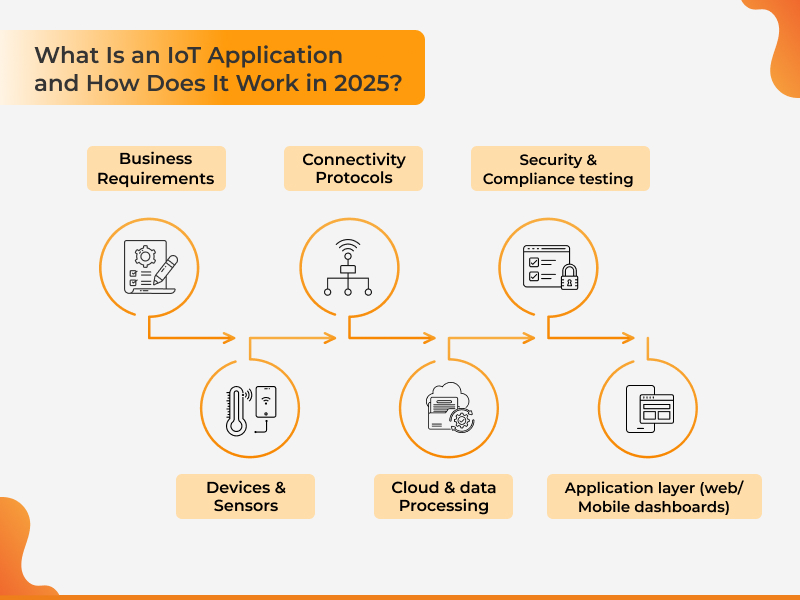
What Is an IoT Application and How Does It Work in 2025?
The Internet of Things is a grid of – linked physical devices. They come with sensors that gather and convert real-time data sets.
Comprehend healthcare sensors that can gather real-time patient vitals, send the information to a central storage, and notify doctors directly.
This is just one real-time IoT application example in the healthcare domain. IoT-driven technology can be successfully used in many other sectors. The IoT is made up of core components that work together.
Devices and Sensors.
Devices or sensors are leveraged to gather and transmit the data. They perform precise actions based on these data sets. For instance, the sensors can be utilized for evaluating temperature and humidity.
There are diverse categories of sensors used in IoT systems. They include temperature and humidity sensors for – environmental monitoring. Proximity, motion, and light sensors help in – detecting movement. Pressure, gas, and GPS sensors support – safety, tracking, and location‑based features.
Connectivity Protocols.
IoT connectivity protocols are the “languages” that devices converse in with each other and send to the cloud. Every connectivity protocol balances power usage, ranges, speed, and cost inversely, which is why IoT systems flexibly blend them.
Zigbee, Z‑Wave, LoRaWAN, NB‑IoT, LTE‑M, and 5G are – some of the most modern connectivity protocols.
Cloud and Data Processing.
When data reaches the cloud components, it enters through secure gateways or IoT hubs. Common cloud components include IoT Hub / Device Gateway, Message queues (MQTT, AMQP, HTTPS), and Stream ingestion services.
The purpose of the cloud ingestion layer can be – authenticating multiple devices, handling millions of connections, and normalizing incoming data.
Application layer (web/mobile dashboards).
The application layer turns processed IoT data into clear information. It delivers this information through web or mobile dashboards. These dashboards show real‑time readings in an easy‑to‑read format.
Users can control devices and change settings. They can trigger actions from the interface. It is the layer that connects human decisions with IoT intelligence.
Why Startups are Investing Heavily in IoT Applications.
Startups are investing in – IoT solutions. The market demand for connected solutions is rising. IoT opens opportunities that help young companies stand out. It reduces operational costs by automating tasks. Startups gain a competitive edge by offering connected products.
- IoT systems scale naturally as the business grows.>
- They generate continuous data that improves decision‑making.
- This blend of efficiency and insight makes IoT a strategic investment.
- With these advantages, it becomes clear how to – build an effective IoT solution.
Step-by-Step Process to – Build an IoT Application.
Building a production-ready IoT application involves – numerous disciplines. It comprises – IoT product engineering, hardware programming, cloud development, and testing. Let us explore a – step-by-step process to develop an IoT application.
Step 1 – Define Business Use Case.
You first need to identify the problem your IoT solution will solve. Healthcare may focus on remote monitoring to reduce emergency visits.
Manufacturing targets predictive maintenance to cut machine downtime. Smart cities look for better traffic flow. Retail uses IoT to improve inventory accuracy.
Each use case must link to measurable KPIs. Common metrics include – cost savings, uptime, response time, and user satisfaction. A use case ensures – the IoT project stays aligned with real business outcomes.
Step 2 – Choose Right Hardware & Sensors.
Selecting the hardware and sensors depends on what your IoT solution measures. Each sensor should match the required accuracy.
Power consumption facilitates – battery‑powered devices. Durability matters when – devices operate outdoors. Cost must be balanced against performance.
A high-end sensor may deliver long‑term savings. Hardware must support easy integration with your connectivity protocol. A thoughtful selection ensures your IoT system stays scalable.
Step 3 – Select Connectivity & Protocols.
Choosing the connectivity and protocols depends on your IoT device operations. Wi‑Fi works well for high‑bandwidth indoor applications. LTE and 5G support mobile-based deployments.
LoRaWAN is ideal for long‑range use cases. NB‑IoT suits devices sending small amounts of data over long distances.
Security features like encryption and device authentication are essential. Strong protocols ensure the IoT system stays reliable.
Step 4 – Build the IoT Platform & Backend.
Building the IoT platform and backend starts with cloud architecture. The cloud must support millions of device connections.
An ingestion layer collects data from sensors in real time. This data is then processed through pipelines. Hot, warm, and cold storage options manage data needs.
APIs enable the platform to communicate with – apps, dashboards, and external systems. Integrations connect the IoT backend with – CRMs, ERPs, or analytics tools. A backend ensures the IoT solution stays future‑ready.
Step 5 – Application Development (Web & Mobile).
App development brings your IoT data to life through – web and mobile interfaces. Dashboards present key metrics in a visual format.
Users can track – device status, alerts, and trends immediately. Real‑time analytics update instantly as new sensor data arrives. This helps making – informed decisions without delays.
Role‑based access ensures each user sees only – what they are authorized to view. Admins get – full control, while customers see limited views. A well‑designed app keeps the – entire IoT experience user‑friendly.
Step 6 – Security, Compliance & Testing.
Security, compliance, and testing ensure – your IoT solution stays trustworthy. Every device must be authenticated.
Strong identity checks – unauthorized access. Data encryption protects – information. Encrypted storage keeps – data safe.
Compliance requirements guide – how data is processed. Standards like – GDPR and HIPAA must be applied. Thorough testing ensures – security control. It validates the system for safety measures.
Comparison: Build In-House vs Partner with an IoT Application Development Company.
| Aspect: | Build In‑House. | Partner with an IoT App Development Company. |
|---|---|---|
| Cost: | Expensive due to – hiring, training, and infrastructure. | More cost‑efficient with predictable pricing models. |
| Time to Market: | Slower because teams build everything from scratch. | Faster development using proven frameworks and expertise. |
| Expertise: | Limited skills across hardware, cloud, and security. | Access to specialists in every layer of IoT. |
| Scalability: | Harder to scale without deep technical experience. | Built‑for‑scale architectures from day one. |
| Resource Requirements: | Requires hiring a full technical team. | No need to expand internal teams early on. |
| Best for Startups? | Not ideal for early‑stage companies. | Smarter choice when launching quickly is the priority. |
What to Look for in Custom IoT Development Services?
Choosing custom IoT development services starts with – checking the provider’s expertise. Teams with domain knowledge understand – real‑world challenges.
They can anticipate technical hurdles before they – slow you down. Experienced providers recommend the right hardware for the product.
They also guide startups in choosing suitable cloud platforms. Their expertise helps select reliable communication protocols. This ensures the entire IoT system works smoothly and efficiently.
Their guidance helps you – avoid costly redesigns later in the project. It is equally important to look for teams that follow – structured processes and transparent communication. This ensures your product moves smoothly right from – concept to prototype to launch.
- End‑to‑end delivery capability ensures handling – hardware, cloud, and applications.
- The unified approach – reduces delays and avoids issues.
- Involved solutions should be – scalable and back future growth.
- Scalability helps the product adapt as – device counts increase.
- A security‑first approach protects – devices, data, and users.
- It reduces long‑term – risks and compliance challenges.
- Strong post‑launch support keeps – the system reliable over time.
- Continuous monitoring ensures – smooth performance.
Types of Custom IoT Development Services Startups Commonly Need.
Startups need IoT consulting & strategy to define the right product direction. Product architecture helps in choosing the – hardware, sensors, and system structure.
- Cloud and data engineering manage device connectivity.
- Mobile and web app development turns raw data into dashboards.
- Maintenance ensures devices and platforms stay secure.
- Ongoing optimization keeps the IoT solution efficient.
These services work together to help startups move from – idea to launch with fewer risks. They enable a stronger technical foundation.
Cost to Build an IoT Application in 2025!
The cost to build an IoT app depends – on many aspects. This includes – hardware, cloud usage, and development complexity. Key cost drivers include – platform architecture, security, and integrations.
- An MVP focuses on core features and is more affordable.
- Modest budgets apply for simple prototypes.
- Higher investments apply to – enterprise IoT platforms.
- Startups can optimize budgets by using scalable cloud services.
- A clear cost breakdown keeps users and stakeholders confident.
- Costs vary based on – device volume, connectivity protocols, and maintenance needs.
- AI‑driven insights and multi‑platform apps can – increase investment.
- Planning early for scalability helps – avoid expensive re‑engineering later.
<p”>With the right IoT product strategy, startups can – balance cost, speed, and performance.
Common Challenges Startups Face in IoT Development (How to Avoid Them).
Startups face scalability issues. They encounter problems when – enabling end-to-end IoT solutions. Sometimes, they face challenges handling – growing device counts.
- Poor device management leads to – inconsistent performance.
- Many teams struggle without – a clear long‑term roadmap.
- Key challenges can be avoided with – architecture planning.
- Regular updates improve – system reliability.
- Future‑ready strategies keep – IoT solutions stable as they scale.
How the Right IoT Application Development Company Accelerates Growth.
The right IoT application development company helps startups reach the market faster. Their expertise reduces technical risks. They bring proven processes that – speed up development. A strong development partner builds – reliable systems.
- Reusable components help teams – move faster with fewer mistakes.
- Deep domain knowledge shortens the – entire development cycle.
- Specialists handle – hardware, firmware, cloud, and security with confidence.
- This expertise helps – startups avoid costly trial‑and‑error.
- They optimize the architecture, so the product performs well.
- These technology solutions are – designed to scale smoothly.
- This combination accelerates overall startup growth.
Moving Forward with Custom IoT Development Services!
A strong IoT strategy brings together the major components. This includes – right hardware, secure connectivity, scalable cloud architecture, and intuitive applications.
Each step in the journey becomes easier when guided by experts. With the right support, companies avoid – pitfalls and accelerate time to market.
Expert teams ensure that – security, scalability, and long‑term reliability are built into the product foundation. This creates a smoother path from – prototype to full‑scale deployment. And helps the solution grow as user needs evolve.
If you are planning to build a future‑ready IoT solution – partnering with an experienced IoT application development company like DaptonCS can help you launch faster and scale with confidence.